Showing posts with label STEM. Show all posts

Saturday, April 26, 2014

Penny for NASA?


If you've been paying attention to the social media, you may have noticed that there's a lobbying group called "Penny for NASA" that is pushing the idea that we should double federal spending on NASA from it's current level of 1/2 of 1% of the federal budget to a full penny of each dollar spent by Uncle Sam. Back at the height of the moon program in the 1960's apparently NASA's budget had been as high as 4+% of the federal budget. Penny for Nasa web site.


Space exploration is exciting, and I suppose it is unsporting of me to point out that there are some awfully strong other contenders for priority in allocating the federal budget.


Their video makes mention of a "petroleum industry subsidy" that dwarfs NASA's budget. So this got me to wondering where exactly to find a line item for "petroleum industry subsidy". Doing a little digging, I find that apparently it is buried in the complexity of the federal income tax and comes in the form of taxes not levied on petroleum industry profits. e.g. See http://thinkprogress.org/climate/2013/01/09/1423351/oil-zero-subsidies/


A presumably harder to sell proposition is: Let's reform the income tax and raise the effective corporate tax rate and then spend more of the revenues on space exploration. If there was a net increase in federal revenues, there are many contenders for the money with deficit reduction at the top of the list. Even if the feds were persuaded to increase the spending on science and technology, I expect NASA would be in for some stiff competition for the money from folks who'd like to see more medical research or more work on alternative energy sources. The old "If we can send men to the moon, why can't we ...", for your favorite choice of "...".


So far, we have visited the moon and established a "permanent" space station in low earth orbit, and done some limited robotic exploration of Mars. Manned exploration of Mars is exciting to discuss, but difficult problems like fatal levels of radiation exposure while in-transit to Mars remain ahead without obvious solutions. Star Trek-ish "shields" and warp drive (to shorten the transit time) don't seem to be in the cards at present.


Perhaps a more do-able objective would be a permanent manned base on the moon to serve as a lower gravity launch platform for deeper space exploration. To be a "Good Idea" I think it would be dependent on showing the base could be built drawing on materials from the moon. Otherwise, maybe the better choice would be an even lower gravity high orbit space station. If nothing else, digging deep to put some of the mass of the moon into use as radiation shielding might make the moon more suitable than a Disney-inspired high orbit permanent space station.


If we're going to have folks be permanent citizens of the moon, it is probably time to re-read Heinlein's "The Moon Is a Harsh Mistress".


Or has Material Science gotten far enough that we should start by building a space elevator?


Certainly there's no shortage of places to spend money, if we have money for such discretionary expenses and the vision and political will for adventure. The politics of the discussion are likely to devolve into debate on the economic stimulus value of the proposed increase in federal spending. An argument for "Investing in the future" sort of demands the context of a long range plan for the future. Even JFK's "we will go to the moon" had more to it than just an intent to go to the moon. http://rdrewd.blogspot.com/2009/07/that-other-thing.html


Am I being too harsh in suggesting that there's much more to consider than just a blind doubling of NASA's budget? The social media would have us believe that the "Penny for NASA" efforts have grass-roots origins. But "Follow the money" is good advice when evaluating any grass-roots movement. If anything, I've over simplified the debate in my article here. e.g. see A Penny for NASA -- or For Congressional Pork

Saturday, April 19, 2014

Bill Gates TED Talks - Ideas Worth Sharing

Bill Gates is the well known founder of Microsoft. I'm not a fan of Bill nor of Microsoft. I am an advocate for "open source" software, and I think Microsoft has brought much harm to the computer industry. But that isn't what this brief article is about.

Bill has given a couple of really good TED talks, short ones, about 10 minutes each. I pointed out this first one before. It advocates more technology in the classroom, specifically video recorders so teachers can assess their teaching sessions.

Teachers Need Real Feedback

A balanced assessment of the idea would have to take George Orwell's concerns from "1984" into account, but as presented, I think the video idea has merit.

A second Bill Gates TED talk, looking at the education problem from an entirely different perspective, is this one:

How State Budgets are Breaking US Schools

Alas, he does better at explaining the problem than he does at suggesting solutions.

What do you think of his suggestions? Is he merely advocating that a larger slice of the education budget should go into technology because that is in his self-interest, or is he showing real forward thinking?

Saturday, August 31, 2013

Out of the Box Thinking - 3D Printers in Space

It is fairly standard advice that if you want to come up with a new solution to a problem, you have to look at it differently. You need to think outside of the box of conventional solutions.


Background

For a while now, I'd been following the growing interest in 3D printers. If you're unfamiliar with them, see my Pearltree on the topic - a shared collection of links to web pages where you can read more about the topic. Short version: A 3D printer is a device that typically extrudes some material (e.g. melted plastic) under computerized control of the position of the nozzle to create a specified object on a platform in a box.


Prototype of a planned 3D-printing spiderbot for construction of buildings on earth. Image borrowed without formal permission from this site.


3D-Printers in Space

From time to time I've read mention of NASA being interested in using 3D printing in space to create replacement parts instead of having to wait for delivery. The FEDEX delivery truck doesn't come by the International Space Station very often. So, I thought, that's interesting. I wonder to what unintended extent the commercial 3D printers depend on gravity. I haven't thought it through, but won't be surprised if it turns out some engineering revisions are needed before a 3D printer designed to work on earth will work properly in a zero-gravity environment. If nothing else, the absence of natural air convection with hot air rising and cold air descending, perhaps will require the addition of forced air cooling to the 3D-printer to be used in space (assuming the printer will reside in a pressurized area where there is air). Cooling times for materials extruded in the vacuum of the great outdoors of space are a whole other thing that needs to be thought through.


And then today I came across this article from the Verge web site, reporting on some plans by NASA to "3D Print" large structures in space. Plenty more questions than answers at this point, but it is clear that I have been guilty of literally confining my thinking about 3D-printing in space to literally be inside the box. The job of the box of a 3D-printer is mostly to support the print mechanism and to provide a frame of reference within which the printer head will move. But in space, with zero gravity, you don't need anything to hold up the printing mechanism. Perhaps a finely adjusted GPS mechanism and laser range-finder can be used to guide positioning of the extruder, and small thrusters can move the extruder from point to point. Once you've literally gotten out of the box, you can think about 3-D printing really large objects, such as rigid beams to hold together gigantic solar arrays - Objects far larger than you'd likely be able to consider launching into space preassembled from the ground.


Seems to me that the hard part is still going to be getting the raw materials (and thruster fuel) into space. Perhaps really large structures fabricated in space will depend upon the hypothetical space elevator to lift materials to orbit for relatively low cost. Of course, if you can lift relatively large things to orbit, an engineering alternative would be to lift prefabricated sections to orbit and then have construction robots that assemble the pieces into the desired large rigid beam structures. Of course, if you can figure out how to 3D-print the desired structures without needing material from earth that might tip things in favor of space-based 3D-printers, but I'm not at all sure how you'd go about fabricating anything from moon dust or the materials of asteroids.

Acknowledgement

Thanks and a tip of the hat to Nuno Cravino for sharing the link to the Verge article on the Google+ STEM Community. It is always good to see reminders from time to time of the importance of thinking outside the box.


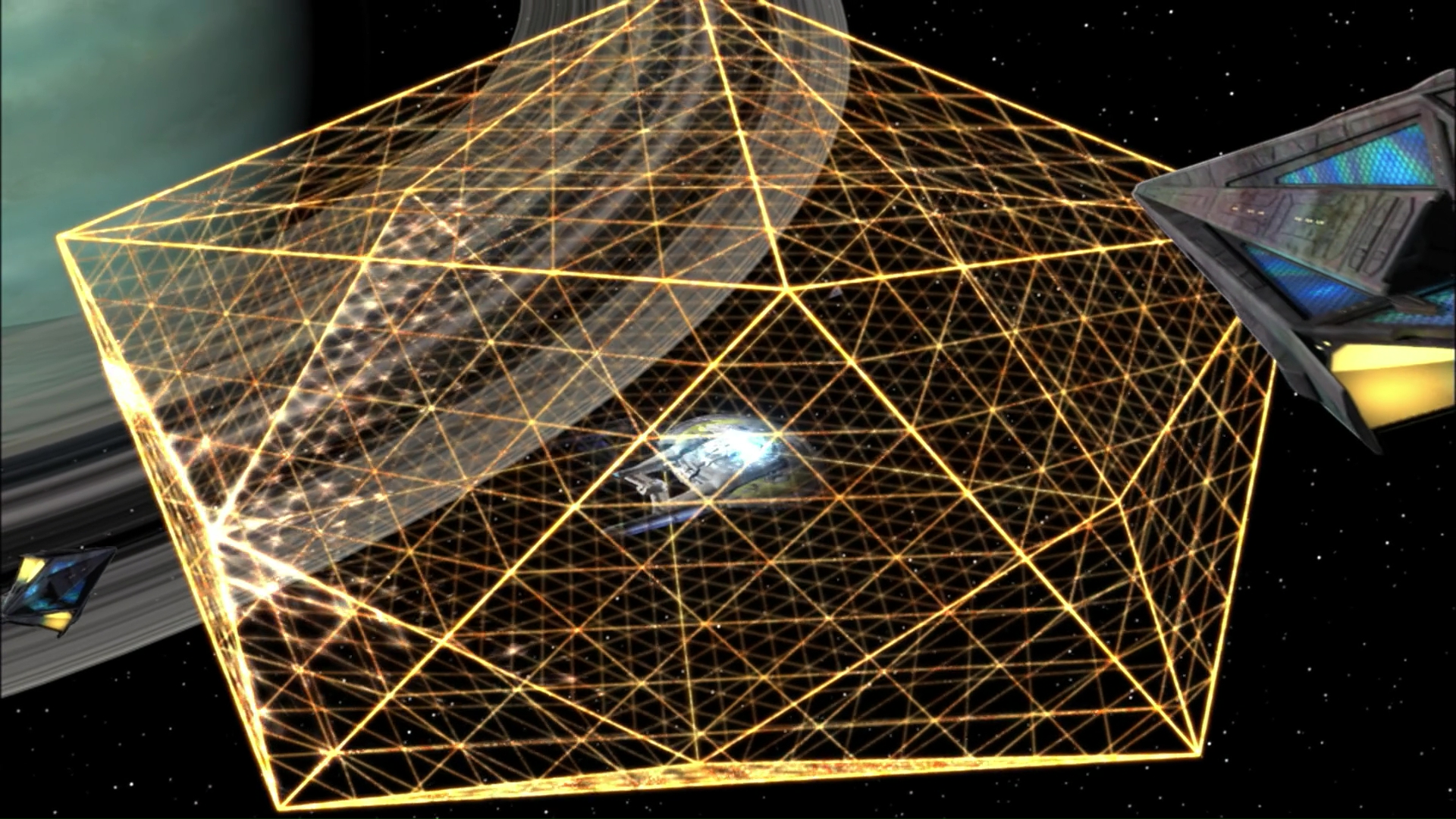
While contemplating the illustration on The Verge article, I remembered there was an old episode of Star-Trek where the Enterprise was trapped in a web-like structure. I'm pretty sure the web was made of energy beams, not solid extruded materials. Thanks to the Internet's excellent reference sites about Star-Trek, all I needed was a Google Search for:


    star trek enterprise caught in a web


to find that was Season 3 Episode 9, 1968's episode "The Tholian Web".


Image borrowed from Memory Alpha.org, the Star Trek Wiki.


imdb.com says there was an actual on-screen mention of the Tholian web in an episode of Futurama.

Wednesday, August 28, 2013

Learn How to Program Computers!

Say What?

News photo of an experimental self-driving Volvo from Engadget report.


Computer procesors show up almost everywhere these days. Desktops, laptops, cell phones, processors embedded in cars, processors embedded in printers, embedded in cameras, embedded in dish-washers.


One thing that they all have in common is that someone (or some team of folks) had to develop a set of instructions to guide the computer to do whatever it is that it does. Those instructions are called programs, software, and the stuff that goes into a program is called "code", not to be confused with "secret codes", though there is a connection if cryptography is what interests you.


So, no matter what, you are pretty much fated to be a user of computer programs, but with some effort on your part, you can learn to write your own computer programs too. Creating a computer program is called "software development". You can learn to do software development on your own. I'll caution up front that seriously big projects generally are tackled by teams, not individuals working solo. But the longest journey starts with but a single step.


My intent here is to convince you that you should embark on the long journey of learning to program computers, to do software development.

Motive

There are plenty of reasons why you should learn how to program computers. Before you begin on that path, you might want to think about what your motive is. Are you hoping to write your own computer games? Want to understand Cyberwarfare before you are noted as a threat by Skynet? Interested in autonomous robots? Self-driving cars? Want to develop a fancy web site of your own? Thinking it might be a useful skill when seeking a serious job? Want to understand how the NSA accidentally intercepted calls from Washington, DC, when they meant to intercept calls from Egypt?


I can't tell you what motivates you. I will caution that this is no short trip, so you should probably be sure you are well motivated before you dive in.


I'll also mention up front that the early days of getting started with developing your own software can be frustrating. As you master the basics, a self-driving car may seem awfully far away. Part of my hope here is that I can convince you that if you keep your motive in mind, you can work through the steep initial learning curve.

Age restrictions?

In my opinion, there's no upper bound on the age when you can learn to program computers. If you are past retirement age, that might alter your own list of motives for learning, but it is no reason to refuse to give it a try.


Can you be too young to learn to program? Well, programming does generally involve reading and writing, so if you haven't gotten proficient at those skills yet, you may find it hard to get into software development. But then, how is it that you are reading this article? The US apparently has regulations that strongly discourage web sites from registering information for children under age 13, so if you are under age 13, it is important that you discuss your plans with your parent or guardian and have permission from them to get involved in online courses.

Cost?

If you have access to a computer with a good Internet connection, you probably have all that you need to get started. If you don't, then how is it that you are reading this article?


Of course, if you have money to invest in this project of yours, there are things you might want to look into. For instance, books. You can get plenty of materials for free here on the Internet, but sometimes it can be useful to have a paper document that you can bookmark, dog-ear, highlight and annotate. Don't feel you have to invest in books up front, but if you can find a good local book store, you may find that there are useful things to be found by browsing. Your local library may also be useful, though in my experience, the local library tends to be woefully short of current technical books. The good news is that if you can find titles worth looking at, perhaps from web searches of places like amazon.com, then most likely your local library can arrange an inter-library loan so you can examine the book without having to buy it first.


Of course, library books, including books borrowed on inter-library loans, need to be treated politely, not dog-eared, high-lighted and given marginal annotations. And they do have to be returned after a relatively short time. If you find a title that looks really well matched to your needs, that's where you just might blow your allowance on an order from an online book-seller, so you'll have a copy of it for your own. Amazon.com does have provisions for wish lists, sort of like bridal registries, so as you publically grow your list of titles you hunger for, you'll at least make it easy for folks thinking about getting you a birthday present or Christmas present.


Libraries can also be a great place for getting free public access to Internet-connected computers. You might find that there are administrative obstacles to your installing software development tools on the library's PC's, or even filters to protect you from the educational materials. Don't let those barriers stop you. Talk to the librarian to find out who is in charge of those kinds of filters. Most likely, arrangements can be made for good reasons like you have.

Courses?

There are many computer programming courses available on the Internet for free. "Massive Open Online Courses", MOOC's, featuring different programming languages and different levels of material. Some aim to serve particularly younger students. You might look, for example, for courses that introduce the "Scratch" programming language.


I haven't taken a "Scratch" course myself, so I'm not going to single out a specific suggestion here. Just try a simple Google search for:


    scratch programming course


and let us know in a comment which course you picked and why, and how that went for you.


But if you feel you are ready to learn a somewhat more conventional programming language, one that will take you further than I believe Scratch will, my suggestion is CS101 from Udacity.com, where you will learn to program using the Python 2 programming language.


The Python programming language continues to evolve. There are Python 3 versions available today. The world is still catching up to that. You'll be fine starting with Python 2, and learning the differences later on to get over to the newer versions. It is important that you know that there are multiple versions and that when you are shopping for books or tools that you get a version that matches what the course is expecting you to have.


There are other courses available, though I haven't tried the others myself. Certainly there are courses that teach Python specifically for game development. And there are plenty of courses that teach other languages, Java and C, for example. But in my opinion, CS101 from Udacity.com is a good place to start. It is free, self-paced, you work on it on your own schedule. Nominally, it is an 8-week course. It doesn't have pre-requisite other courses. I believe it is an excellent place to get started with MOOC's. There's a final exam at the end and when you pass it, they will e-mail to you a certificate to commemorate your accomplishment. There are reports on the web of real colleges that even give credits if you are a registered student and pass the Udacity.com CS101 course, but being a registered student at a physical college is outside the realm of stuff you can try for no charge.


If nothing else, trying a MOOC to get started will show you if this is a field that holds your interest. I know software development has been a long standing interest of my own, but I also know that some fraction of the students who try it find that they absolutely hate programming. If you find that's the case for you, my advice is that you tough it out to completion of the introductory course and then look for other fields that do hold your interest. It's only a couple of months to work through Udacity CS101, and it isn't anything like a full-time course load while you are working through just the introductory course. Getting the certificate isn't good motive to start the course, but perhaps it is a good motive to stick it out to the end.

Where to find more?

code.org is a web site that advocates that everyone should learn how to code. They offer 3 editions of a promotional video to promote interest in the field. One is a 1-minute teaser. Another is a 5-minute edition featured on their web site's front page. And if you have 10-minutes to spare, there is a full edition available.


There are links on the code.org site to various local places to learn to program. For example, there's a brief plug there for the "Yes We Can Community Center" here in Westbury, NY.


Details of the schedule are not yet nailed down for Fall 2013, but if you are local to here, one way to take on CS101 is to sign up with the Community Center. The Center has the computers and Internet access, and it will have other students so you won't feel too much that you are on-your-own. And, for what it worth, I'll be available to answer questions and help keep you motivated while you are working through the course online.


Not quite free, as there is a membership fee to sign up with the Community Center. But use of the basketball courts, game room and locker room and access to quiet study space for your homework time all come with that membership, so it's probably worth joining if this is your community. (Use of the fitness center is not included in basic membership. Sorry).


The schedule I've proposed is that Monday evenings we'd meet as a class to share discussion of progress and problems. Other school nights I'd be available to answer questions 7-9PM or by appointment.


In any case, you can try udacity.com CS101 on your own before we even get started and then continue at the Community center once we get our act together there. Please, do let them know at the front desk that you're interested in taking CS101 as seating is limited.

Free for Senior Citizens

If you are a resident of North Hempstead and are age 60 or more, you are eligible for free membership in Project Independence and get a free community center membership too when you join Project Independence. Such a deal!

Further reading

Benefits of Teaching Kids To Code That No One Is Talking About - This blog post by an online acquaintance of mine has an example of a Scratch program, and a link to a video of a talk by the creator of Scratch.


Is Udacity CS101 Watered Down - This is a blog post from me in December 2012, describing what you should expect to get out of the online Udacity CS101 course.


Where to Get Python - This is another blog post from me. This one describes how you can install Python on your own PC. Note that back when I wrote that, Udacity was still using Python 2.6, but the course has since updated it's software to Python 2.7. From an end-user point of view that's an almost imperceptible change.


There are numerous Youtube videos available about learning to program games. Here is Episode 1 of a series that is dozens of videos long. Part 1 shows off a couple of games the guy has written in Python and describes what prerequisite knowledge he expects you to have to get started with his tutorials.


This isn't the first time that I've written about plans for CS101 at the Community Center. For more details of my intended format for the weekly meetings, see my blog article: Marketing the Importance of Programming Education

Wednesday, June 12, 2013

A Chem teacher cautions against "Pseudoteaching"

Several times now I've come across mentions of "Pseudoteaching" in my reading, and I confess to not quite grokking what that meant. Today, the Google+ STEM community shared this short video and I think I'm beginning to understand.

"Blow something Up!"

I remember Mr. Greenberg, my high school chemistry teacher, but on the one hand I have trouble cataloging him as an "entertainer', but on the other hand I was always troubled by the seeming "magic" in chemistry class. See, when we stir these 2 clear liquids together, it turns pink. My brain would gripe "Why?". And that's probably why I went into software, not chemistry.

I think this video pairs nicely with the one linked to my blog post of 02/2013 "STEM Education Ideas".

Friday, March 1, 2013

Marketing the Importance of Programming Education

At the risk of sounding like Dr. McCoy complaining to Captain Kirk in the original Star-trek TV series, I'm a software engineer, not a marketeer. At my request, the local high school and local BOCES school have announced the availability of a mentored edition of udacity.com's CS101 at the "Yes We Can" Community Center here in the New Cassel section of North Hempstead, NY. My plan is to have weekly meetings of the class at 7PM, Monday, starting March 4, for a Scrum-inspired stand-up meeting where each student will say what they did on the course in the past week, and what they will do this week, and what impediments they see in their way. Other school nights I'll be available 7-9PM to answer questions and the students can put in whatever hours they want to at the community center or if they have the Internet at home, they can work on the course at home. Udacity provides little in the way of a "dashboard" for tracking the progress of the students in a class, so I'm hoping the Scrum-style stand-up meeting will enable me to track progress and figure out who needs extra attention. And, I hope it serves to persuade student's to live up to their announced plans and keep on keeping on. I've prepared a small set of slides to use at the first night's meeting.

But, as of Tuesday this week, the community center tells me no students have enrolled so far. I've nudged my contacts at the high school and BOCES school to see if we can get some students motivated to come check it out. My plan is to show up on Monday evening and bring a book to keep me busy if it turns out I'm there by myself.

Meanwhile, code.org, a non-profit has appeared on the Web to promote the proposition that Every student should have a chance to learn to code. To get people's attention, they've posted to YouTube an "all-star" video in 3 editions. 1 minute, 5 minutes and 10 minutes. What most school's don't teach.

If you've been following my blog here this month, you may have seen the video from Jörn Loviscach, "MOOC's and other faster horses" that I had linked to my recent post "Education and Technology". Loviscach is one of the udacity.com professors. He reported some scary statistics about how the MOOC's typically start out with hundreds of thousands of students, but a huge fraction (90%) typically drop the course. The classroom at the community center only seats about 12 students and even if I had an overwhelming demand for CS101, I don't think we could accomodate more than a Monday team and a Tuesday team. I don't want to get into a situation where we've overcommited the center's PC's so students who show up to work on the course can't get a seat. Bottom line is that unless I can influence that retention rate as part of my local mentoring of the class, I may not live long enough to see anyone actually complete the course. Hence my concern about "retention".

I agree that every student should have a chance to learn to code. Now if I can only manage to recruit and retain some students. I'll blog about how things go. So stay tuned, please. To paraphrase Scotty from Star-Trek, I may think of myself as a software engineer, but I'm a marketeer now. And if you know anyone in North Hempstead, NY, please encourage them to visit the Yes We Can Community Center on Garden Street and sign up for CS101.

Monday, June 22, 2009

Cornell Hydraulics Lab

Cornell Hydraulics Lab

The Cornell University campus in Ithaca, NY sits atop a hill overlooking downtown Ithaca and the southern tip of Lake Cayuga, one of the finger lakes of New York state.  The campus is bounded on the north and the south by deep gorges.  (The basis for the bad pun on all those "Ithaca is gorges" T-shirts).  Well, "bounded" is too strong a word as bits of campus have long since spilled across Cascadilla Gorge into College Town to the south of the main campus; and to the north of Fall Creek gorge, North Campus is a nearly city-sized collection of dormitories.

Fall Creek gorge had the interesting feature of the long-abandoned Hydraulics Lab built into the wall of the gorge just below Beebee Lake.   In 2005, some relatives of a Cornell student took a trip to Ithaca and they posted a very nice web page documenting the trip with pictures and words.  Among their pictures was this photo of the Hydraulics Lab, which they captioned "Fall Creek and the Hydraulics Lab from the Thurston Avenue Bridge."
Sadly, their web page has since vanished, so I've substituted here a similar image of a postcard of the same view. (3/6/20129)


In good weather, the Cornell campus is a fabulously beautiful place. If you are unfamiliar with it, click on the "campus" link up above here. Click on the virtual tour check box just below the map and click on the various panorama points on the map to see various 360-degree pictures of the place. "Stroll around the grounds a bit, until you feel at home".

Memorial Day weekend, 2009, I went back to visit the Cornell campus.   Through fortuitous bad planning, that turned out to be the weekend for Cornell's graduation ceremony.  (No wonder I'd had such a hard time reserving a hotel room - we ended up in a hotel in Owego, about 30 miles to the south of Ithaca).  I picked up a graduation edition of the Cornell Daily Sun in the lobby of Willard Straight Hall and didn't get around to reading it until I'd gotten home.  I was surprised to learn from the paper that one cold night in February, 2009, the hydraulics lab collapsed into the gorge.   That motivated me to look for more info on the web and I found a March 2009 Cornell Daily Sun article (link now dead, sniff, sniff) about the proposed clean-up of the site.   That article included this wintery "after" photo:

Vanishing act: The remains of the old Hydraulics Lab,
 which collapsed into Fall Creek Gorge

Alas, in 9/2013 that archived article and the photo were tidied up from the Sun's web site. Happily, I found another copy of the photo on George Lowery's Cornell blog.


If you look at the "after" photo, you can see the large vertical water pipe that must have been the central feature of the lab at the time it was in use

The Hydraulics Lab had stood for 111 years.  The estimate is that to remove the remnants will cost a million dollars.  That leaves me wondering what did it cost to build the lab in the first place?  The rock of the building matched the walls of the gorge very nicely.  Was the rock for the building carved from the site or is most rock in the area roughly the same color as the gorge walls?

Can you imagine the expense and time it would take to try to build such a lab on that site today?  I'm sure it would have to be fully handicapped accessible, and would require bathrooms and a sewage system connection.   Most likely it would never get the necessary permits at all, but if it did, and if in another 111 years the modern replacement was to again collapse into the gorge, my hunch is that it would leave a heck of a lot more debris than the above picture shows.

Thinking about the old lab got me to wondering.   What motivated the engineering school to build such a lab on so challenging a site as this one more than a century ago?  The more I thought about it, the more I realized that engineering has sure changed a whole bunch since the late 1800's.  I entered Cornell's Engineering school in 1970.  As a freshman, I was in a select group that, as an experiment, studied PL/C computer programming instead of mechanical drawing.   Within a year or 2, the T-squares, drawing boards, triangles and mechanical drawing classes were gone entirely.   PL/C was a Cornell variant of the PL/I programming language.  PL/I's lifespan didn't turn out to be as long as that of T-squares.  Computing in 1970 was mostly batch processing.   We'd submit our programs on 80-column punched cards and get our error messages back on fanfold printouts that would come off a line-printer.  The printers would only print in upper case, unless you made special arrangements for a print-chain to be mounted that included lower case letters.   The Internet and the Web, even PC's were still many years off into the future.   Cornell's computer was an IBM 360/65 mainframe located off-campus out near the Ithaca airport that did both academic and administrative processing.  The computing facilities in Upson, Clark and Warren Hall's were just remote job entry stations, little (Well, the size of a kitchen counter. That's "little" compared to a room-sized 360/65) 360/20 computers to drive the card reader(s) and line printers and a 56Kbps (?) communication line to the mainframe at Langmuir Labs.  The giant mainframe had a total of 512KB of memory.   Today when I type that I have to force my fingers to type that K because my reflex is to think 512MB of memory would be unthinkably small.  (Just this weekend a friend asked me to look at his notebook PC to see why it was so slow.  I pointed out that he was running Windows Vista with only 1GB [that's 1024MB which is 2048x as much memory as Cornell's mainframe had back in the day] of memory).

So 35 years since I graduated from Engineering school, I'm wondering how did I ever write papers and stuff without Google.  I had a mechanical portable typewriter and if it hadn't been for corrasable paper, I'd probably have been stuck in high school until word processors became available.   They became available on campus to undergrads about 1973.   I remember Tim Metcalf, my very forward thinking roommate, used the by-then available online computer terminals to produce his resume while job hunting our senior year.   My portable typewriter and ream of corrasable paper apparently slipped through a window of opportunity as checking today for the correct spelling of corrasable, I find that that kind of paper apparently has been banned for final copies of thesis submissions as it doesn't have proper archival properties for long term shelf life of the typed documents.  If you wanted to buy such paper today, good luck to you.   Staples doesn't have it.   But then I was mildly surprised to find Staples still has a selection of a dozen varieties of typewriter to chose among.

But think back to the late 1800's when campus buildings were not yet wired for electricity.   Were there gas lights in the dorm rooms?  My memory of hydraulics as a topic in 1970's physics classes were maybe an experiment with a couple of columns of water, different diameter columns, connected to each other at the bottom with some tubing.  At first I was asking myself what the academic value was of a huge steel pipe encasing a column of water many feet tall in that ancient hydraulics lab to have justified the trouble and expense of building that hydraulics lab.  Then it hit me, hydraulics in the late 1800's surely wasn't something you'd only encounter in the service station's "lift" for raising your car for an oil change.   Hydraulics must have encompassed the study of water power for driving machinery.  Now I'd feel more confident in this speculation if I could find something about a large steam engine elsewhere in the engineering school to study another major source of mechanical power in the late nineteenth century.  I Googled for

cornell steam engine

and didn't find anything about a steam engine lab, but I did find an online copy of an 1878 book about steam engines by Cornell Professor Robert Thurston, and mention of a patented improvement to the steam engine that had been invented by Cornell Professor J. E. Sweet that apparently was the foundation of Brampton, Ontario having a manufacturing industry.

Hmm...  Given my tendency to have my attention wander off to tangentially related topics, maybe I'm lucky that Google wasn't around to distract me when I was in college.

In case you were wondering, the collapsed Hydraulics Lab was quite separate from the Cornell hydroelectric plant.   From digging around on the web, the Fall Creek hydroelectric plant was built in 1904.  By the time I was at Cornell in the 1970's, the plant had fallen into dis-use, but during one of the various energy crises (1981), the hydro electric plant was restored and apparently remains in service today.


If you do visit Cornell, be sure to wear comfortable walking shoes.  Puzzling that there hasn't been significant seismic activity in Ithaca, yet I found the hills are significantly steeper now than they were in 1970.  It's still a stunningly beautiful place to visit in the Spring or anytime that isn't winter.

Drew
Revised 08/03/2009 to fix a typographic error.
Revised 06/03/2010 to replace the link to the Cornell steam engine article.    The old link has gone 404 on me.
Revised 5/4/2013 to fix the URL's of the images. Old URL's as posted no longer worked, but thankfully the pictures are still online
Revised 9/21/2013 to replace the photo of the collapsed lab as the Cornell Sun copy has vanished from the web.
Revised 9/22/2013 to replace the link to the campus map, which went 404 on me too. New map has virtual tour feature! Revised mention of IBM 360's to provide a link to a web page to show what they look like lest I mislead in describing the "360/20" as "little".
Hey! Didn't you get the memo about Web 2.0? The idea is that you aren't stuck just reading the site. If you run into a missing photo or broken link or typo or even a bad idea, you can leave a comment to let me know about it, so I can fix things up.
Revised 9/22/2013 to replace the links about the hydroelectric plant with links that are currently in good working order.
Revised 9/22/2013 to replace the link about corrasable paper not being acceptable for theses final submission to put in a link that is currently in working order.
Revised link to staples web site and noted that they now have even more typewriters listed than they used to.
Revised 3/6/2019 to replace the now missing images of the hydraulics lab (before) and the again vanished image of the hydroelectric plant. Lesson is, if the image is to be incorporated into the article, I need to make my own copy of the file. Seemed more polite to just link to the original image, but not reliable over time.