Showing posts with label space. Show all posts

Saturday, April 26, 2014

Penny for NASA?


If you've been paying attention to the social media, you may have noticed that there's a lobbying group called "Penny for NASA" that is pushing the idea that we should double federal spending on NASA from it's current level of 1/2 of 1% of the federal budget to a full penny of each dollar spent by Uncle Sam. Back at the height of the moon program in the 1960's apparently NASA's budget had been as high as 4+% of the federal budget. Penny for Nasa web site.


Space exploration is exciting, and I suppose it is unsporting of me to point out that there are some awfully strong other contenders for priority in allocating the federal budget.


Their video makes mention of a "petroleum industry subsidy" that dwarfs NASA's budget. So this got me to wondering where exactly to find a line item for "petroleum industry subsidy". Doing a little digging, I find that apparently it is buried in the complexity of the federal income tax and comes in the form of taxes not levied on petroleum industry profits. e.g. See http://thinkprogress.org/climate/2013/01/09/1423351/oil-zero-subsidies/


A presumably harder to sell proposition is: Let's reform the income tax and raise the effective corporate tax rate and then spend more of the revenues on space exploration. If there was a net increase in federal revenues, there are many contenders for the money with deficit reduction at the top of the list. Even if the feds were persuaded to increase the spending on science and technology, I expect NASA would be in for some stiff competition for the money from folks who'd like to see more medical research or more work on alternative energy sources. The old "If we can send men to the moon, why can't we ...", for your favorite choice of "...".


So far, we have visited the moon and established a "permanent" space station in low earth orbit, and done some limited robotic exploration of Mars. Manned exploration of Mars is exciting to discuss, but difficult problems like fatal levels of radiation exposure while in-transit to Mars remain ahead without obvious solutions. Star Trek-ish "shields" and warp drive (to shorten the transit time) don't seem to be in the cards at present.


Perhaps a more do-able objective would be a permanent manned base on the moon to serve as a lower gravity launch platform for deeper space exploration. To be a "Good Idea" I think it would be dependent on showing the base could be built drawing on materials from the moon. Otherwise, maybe the better choice would be an even lower gravity high orbit space station. If nothing else, digging deep to put some of the mass of the moon into use as radiation shielding might make the moon more suitable than a Disney-inspired high orbit permanent space station.


If we're going to have folks be permanent citizens of the moon, it is probably time to re-read Heinlein's "The Moon Is a Harsh Mistress".


Or has Material Science gotten far enough that we should start by building a space elevator?


Certainly there's no shortage of places to spend money, if we have money for such discretionary expenses and the vision and political will for adventure. The politics of the discussion are likely to devolve into debate on the economic stimulus value of the proposed increase in federal spending. An argument for "Investing in the future" sort of demands the context of a long range plan for the future. Even JFK's "we will go to the moon" had more to it than just an intent to go to the moon. http://rdrewd.blogspot.com/2009/07/that-other-thing.html


Am I being too harsh in suggesting that there's much more to consider than just a blind doubling of NASA's budget? The social media would have us believe that the "Penny for NASA" efforts have grass-roots origins. But "Follow the money" is good advice when evaluating any grass-roots movement. If anything, I've over simplified the debate in my article here. e.g. see A Penny for NASA -- or For Congressional Pork

Saturday, August 31, 2013

Out of the Box Thinking - 3D Printers in Space

It is fairly standard advice that if you want to come up with a new solution to a problem, you have to look at it differently. You need to think outside of the box of conventional solutions.


Background

For a while now, I'd been following the growing interest in 3D printers. If you're unfamiliar with them, see my Pearltree on the topic - a shared collection of links to web pages where you can read more about the topic. Short version: A 3D printer is a device that typically extrudes some material (e.g. melted plastic) under computerized control of the position of the nozzle to create a specified object on a platform in a box.


Prototype of a planned 3D-printing spiderbot for construction of buildings on earth. Image borrowed without formal permission from this site.


3D-Printers in Space

From time to time I've read mention of NASA being interested in using 3D printing in space to create replacement parts instead of having to wait for delivery. The FEDEX delivery truck doesn't come by the International Space Station very often. So, I thought, that's interesting. I wonder to what unintended extent the commercial 3D printers depend on gravity. I haven't thought it through, but won't be surprised if it turns out some engineering revisions are needed before a 3D printer designed to work on earth will work properly in a zero-gravity environment. If nothing else, the absence of natural air convection with hot air rising and cold air descending, perhaps will require the addition of forced air cooling to the 3D-printer to be used in space (assuming the printer will reside in a pressurized area where there is air). Cooling times for materials extruded in the vacuum of the great outdoors of space are a whole other thing that needs to be thought through.


And then today I came across this article from the Verge web site, reporting on some plans by NASA to "3D Print" large structures in space. Plenty more questions than answers at this point, but it is clear that I have been guilty of literally confining my thinking about 3D-printing in space to literally be inside the box. The job of the box of a 3D-printer is mostly to support the print mechanism and to provide a frame of reference within which the printer head will move. But in space, with zero gravity, you don't need anything to hold up the printing mechanism. Perhaps a finely adjusted GPS mechanism and laser range-finder can be used to guide positioning of the extruder, and small thrusters can move the extruder from point to point. Once you've literally gotten out of the box, you can think about 3-D printing really large objects, such as rigid beams to hold together gigantic solar arrays - Objects far larger than you'd likely be able to consider launching into space preassembled from the ground.


Seems to me that the hard part is still going to be getting the raw materials (and thruster fuel) into space. Perhaps really large structures fabricated in space will depend upon the hypothetical space elevator to lift materials to orbit for relatively low cost. Of course, if you can lift relatively large things to orbit, an engineering alternative would be to lift prefabricated sections to orbit and then have construction robots that assemble the pieces into the desired large rigid beam structures. Of course, if you can figure out how to 3D-print the desired structures without needing material from earth that might tip things in favor of space-based 3D-printers, but I'm not at all sure how you'd go about fabricating anything from moon dust or the materials of asteroids.

Acknowledgement

Thanks and a tip of the hat to Nuno Cravino for sharing the link to the Verge article on the Google+ STEM Community. It is always good to see reminders from time to time of the importance of thinking outside the box.


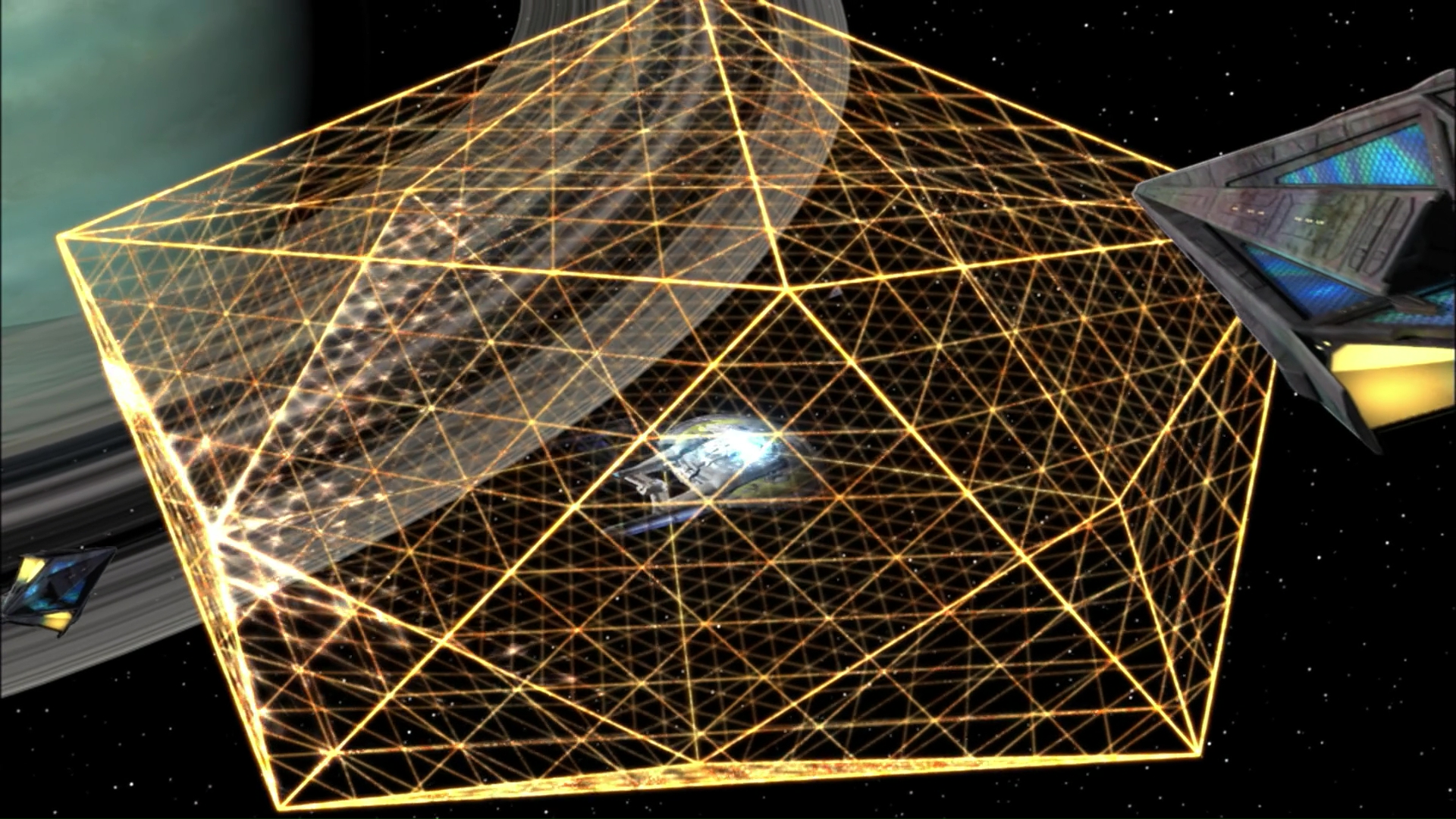
While contemplating the illustration on The Verge article, I remembered there was an old episode of Star-Trek where the Enterprise was trapped in a web-like structure. I'm pretty sure the web was made of energy beams, not solid extruded materials. Thanks to the Internet's excellent reference sites about Star-Trek, all I needed was a Google Search for:


    star trek enterprise caught in a web


to find that was Season 3 Episode 9, 1968's episode "The Tholian Web".


Image borrowed from Memory Alpha.org, the Star Trek Wiki.


imdb.com says there was an actual on-screen mention of the Tholian web in an episode of Futurama.

Thursday, July 23, 2009

The Other Things


The Other Things

Unless you've been far far away from the media this week, surely you're aware that this week marked the anniversary of the landing of man on the moon 40 years ago.  Over and over again, the TV has  been playing various sound bytes from John F. Kennedy's September 12, 1962 speech where he says "We choose to go to the moon in this decade".   In case you missed it here's a short clip:

Each time I listened to that speech this week, I noticed that he says  "We choose to go to the moon in this decade and do the other things...".   Generally the sound bite is like the one I linked to, trimmed enough as to remove all clues as to what "the other things" were.

Inquiring minds want to know.   So I dug to find the rest of the speech.

Here's a longer clip from that same speech that gives enough context to let you find what "the other things" were.

So, "the other things" were the hard science to make possible going to the moon and going on from there to explore space.   If he'd had some west coast speech writers he might have said "to boldly go where no man has gone before".  What I like about the speech is he was clearly pushing spending money for scientific research.  I often hear politicians suggesting that it would be good to fund things like curing AIDS or cancer, but nothing I can recall from recent speeches has said we, as a nation, need more scientists.

Here's a far longer video of that same speech:

http://www.youtube.com/watch?v=TuW4oGKzVKc (17 minute, 42 second version)

I was surprised to learn that the speech was not the speech where he first set the goal of the US getting to the moon in the 1960's.   In fact, the speech was in Houston and by September, 1962, there had apparently already been major strides in shaping the space program.  Houston evidently had already been picked for Mission Control and he describes Cape Canaveral's planned Vertical Assembly Building and the Saturn rocket engines.

Looking into that, I learned that the Saturn and a lunar landing program (with a target of the late 1960's) were already in the works in the Eisenhower administration.

As I was digging for that "We choose to go to the moon" speech, I came across this May 25, 1961 speech by Kennedy to Congress.

4-page transcript of 1961 "let's go to the moon" speech

Excerpt---

First, I believe that this nation should commit itself to achieving the goal, before this decade is out, of landing a man on the moon and returning him safely to the earth. No single space project in this period will be more impressive to mankind, or more important for the long-range exploration of space; and none will be so difficult or expensive to accomplish. We propose to accelerate the development of the appropriate lunar space craft. We propose to develop alternate liquid and solid fuel boosters, much larger than any now being developed, until certain which is superior. We propose additional funds for other engine development and for unmanned explorations--explorations which are particularly important for one purpose which this nation will never overlook: the survival of the man who first makes this daring flight. But in a very real sense, it will not be one man going to the moon--if we make this judgment affirmatively, it will be an entire nation. For all of us must work to put him there.

But wait, there's more!

Secondly, an additional 23 million dollars, together with 7 million dollars already available, will accelerate development of the Rover nuclear rocket. This gives promise of some day providing a means for even more exciting and ambitious exploration of space, perhaps beyond the moon, perhaps to the very end of the solar system itself.

Rover nuclear rocket??  I had to look that one up.   The expectation was you'd need such a thing to go to Mars.

So that program died about 1972 when it was clear there was no plan to try for Mars as a follow-on to reaching the moon.

But back to Kennedy's 1961 speech to Congress.   It also proposed 2 more items.   Item 3 was development of communications satellites.  Item 4 was development of weather satellites.   Hey!  No mention of GPS?

All that space program stuff was in section IX of the speech.   The other sections are interesting reading too.   The economy was recovering from another recession and the cold war was quite a bit more war-like than in later years when diplomacy requires that we say only nice things about the other countries.

The great battleground for the defense and expansion of freedom today is the whole southern half of the globe--Asia, Latin America, Africa and the Middle East--the lands of the rising peoples. Their revolution is the greatest in human history. They seek an end to injustice, tyranny, and exploitation. More than an end, they seek a beginning.

And theirs is a revolution which we would support regardless of the Cold War, and regardless of which political or economic route they should choose to freedom.

For the adversaries of freedom did not create the revolution; nor did they create the conditions which compel it. But they are seeking to ride the crest of its wave--to capture it for themselves.

Yet their aggression is more often concealed than open. They have fired no missiles; and their troops are seldom seen. They send arms, agitators, aid, technicians and propaganda to every troubled area. But where fighting is required, it is usually done by others--by guerrillas striking at night, by assassins striking alone--assassins who have taken the lives of four thousand civil officers in the last twelve months in Vietnam alone--by subversives and saboteurs and insurrectionists, who in some cases control whole areas inside of independent nations.

The talk of revolution reminds me of that routine by Hispanic comedian George Lopez who says that not only will the revolution be televised, but that it will be closed-captioned in Spanish.

Kennedy's speech was not the sort of words you'd pick to bill and coo with, say, a country you were depending upon to snap up tons of IOU's as if that paper was going to be worth something some day.   Maybe one day we'll have a national going-out-of-business sale.  How much of the national debt could we barter away in exchange for Michigan, including full rights to the factories of a couple of once-major auto manufacturers?  Probably not enough.

In closure, here's a brief collection of great presidential speeches.  Think history will be kind to them all?

http://www.youtube.com/watch?v=6rkb_wkfjyo&feature=related (36 seconds)


Drew